
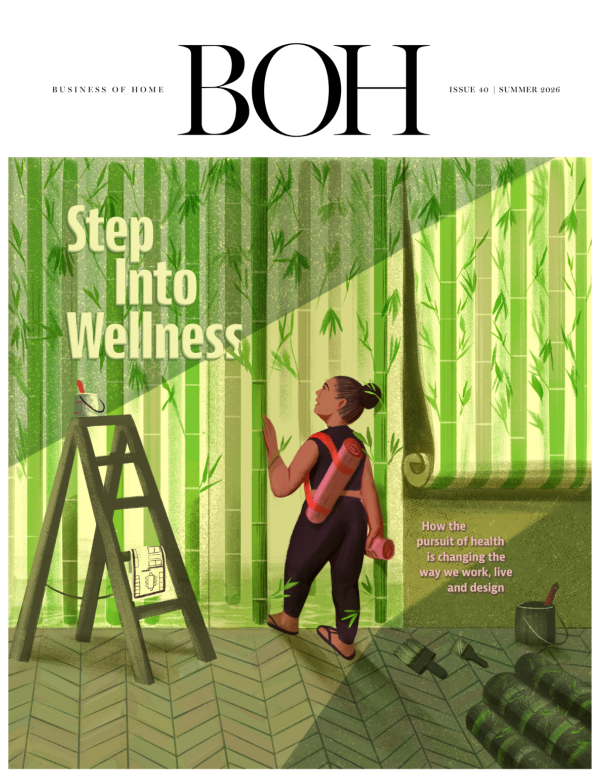
HOW THE PURSUIT OF HEALTH IS CHANGING THE WAY WE WORK, LIVE AND DESIGN.
By: Hannah Hickok
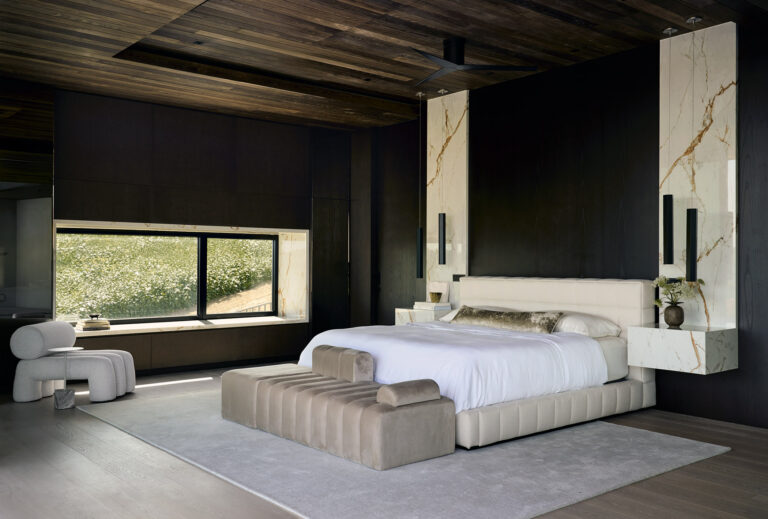
Customizing a home for longevity may be a heavy lift, but experts agree that the goal of these spaces is always for residents to feel a sense of effortlessness and flow in their normal routines. “We are moving toward spaces that are more responsive, restorative and integrated into daily life rather than wellness being treated as a separate destination or experience,” says Nina Magon, whose Houston-based firm is currently at work on her latest venture: a new local wellness high-rise condo complex called KA Residences, which will include features like circadian lighting, advanced oxygenation systems and dedicated wellness suites within each unit. “The future will be less about visible wellness features and more about invisible systems and intentional environments that quietly improve how people live, recover, focus and connect every day.”
In the field, healthy-home know-how is more than just technical prowess. Schreibies Smith relies on a healthy dose of critical thinking and instinct to fill in the gaps where industry knowledge falls short. “There are qualities in the built environment that we all know feel better, and now through neuroscience, neuroaesthetics and [medical monitoring], we can see the positive impact these spaces have on heart rate, blood pressure and cortisol,” she says. “I hope those metrics ultimately end up empowering us to trust our intuition and feelings. Typically as a Western society, we say, ‘It might feel good, but that’s not enough.’ But feeling good actually is enough, and here’s the science to prove it.”
The most impactful business shift Magon made in order to attract more of this type of work was to shift her approach—namely, to stop approaching wellness as an amenity and instead see it as a core design value. “Rather than adding wellness features at the end of the project, I have become increasingly focused on how architecture, materials, lighting, acoustics and spatial flow impact not just aesthetics, but human performance, recovery and overall well-being,” she says. “Wellness is the new luxury. Focusing only on aesthetics—in my book, that is not design anymore.”
Although features like custom furniture, plunge pools and meditation rooms may be found primarily in higher-budget projects for now, wellness designers are hopeful that won’t always be the case. Schreibies Smith says that the key to healthy home design at a lower price point often lies in a streamlined approach: “You can accomplish it at any level; you just need to simplify what’s going into the building. You can still use high-quality materials—but less of them, in a smaller footprint.”
Magon also believes we’ll soon see a trickle-down effect from the luxury market to mainstream homes. “Wellness design will become less about exclusivity and more about creating healthier everyday environments for everyone,” she says. “Many principles that began in high-end residential and hospitality spaces—like circadian lighting, improved air and water quality, acoustic comfort, ergonomic planning, low-toxicity materials, and a stronger indoor-outdoor connection—will be in everyday homes, multifamily developments, offices and public spaces. True wellness design should ultimately enhance quality of life across all demographics and lifestyles.”

